

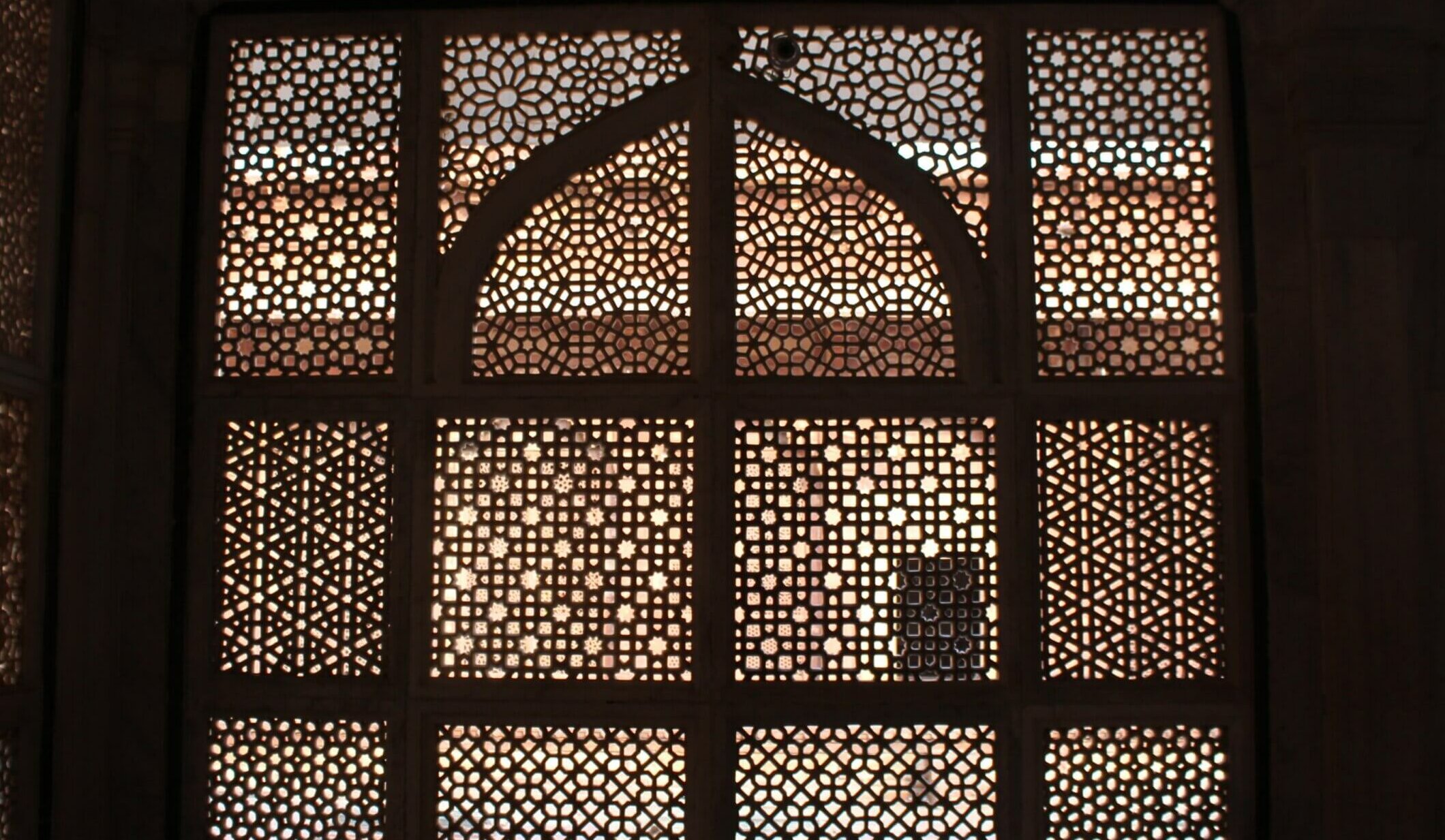
Few architectural elements speak to the elegance, ingenuity and cross-cultural reach of Islamic civilisation like the jali. These intricately carved screens of stone, marble, or wood – characterised by their repeating geometric and floral motifs – are more than decorative flourishes. They are feats of design that speak to a deep understanding of light, climate, and privacy. From Mughal India to contemporary Europe, the jali has travelled across centuries and continents, transforming both buildings and the ideas behind them.
A window through time: The history of jali
Though often associated with Mughal architecture, jali design has far deeper roots in the Indian subcontinent. Early versions appeared in temples across Gujarat, where artisans carved relatively small-scale perforations into stone. As Islamic sultanates – such as the Delhi and Gujarat Sultanates – emerged from the 13th century onwards, they brought with them new motifs and styles, including patterns inspired by the geometry of the Islamic West.
It was the Mughals, Sunni Muslim rulers from Central Asia, however, who elevated jali to a symbol of imperial refinement. Established in the 1500s, the vast Mughal Empire, stretching from modern-day Afghanistan to Bangladesh, fused Persian aesthetics with local Indian traditions, giving rise to jali patterns of exquisite complexity. Under the first Mughal Emperor Babur and his successor Humayun, arabesque and geometric designs dominated. The third Emperor Akbar introduced simpler hexagonal motifs, whilst the fifth Shah Jahan – architect of the Taj Mahal – ushered in a more floral, naturalistic style influenced by both Ottoman and Safavid art.
Jali’s aesthetic travelled well beyond the subcontinent. In the 20th century, figures like art historian Stuart Cary Welch and philanthropist Doris Duke helped introduce jali motifs to Western architecture and interior design. Today, these patterns grace everything from global museum exhibitions to modern facades, evidence of their universal appeal.
Function meets beauty: The purpose of jali
The jali is a masterclass in multi-functional design. Its patterned perforations are not just beautiful – they’re practical. Historically, jalis served to moderate light, temperature, and airflow in a variety of climates, especially in South Asia’s intense summer heat. By diffusing sunlight, they reduced glare and solar gain, offering a form of passive cooling long before modern air conditioning systems.
In temples, early jalis filtered sunlight to soften the atmosphere, encouraging spiritual focus. Later, in both secular and sacred Islamic architecture, they helped regulate humidity and created microclimates within buildings. A 2022 study in the International Research Journal of Engineering and Technology confirmed that a jali’s ‘perforation percentage’ directly affects a building’s thermal performance. In dry zones like Rajasthan, smaller perforations amplify the Venturi effect, improving evaporative cooling; in humid areas like Kerala, larger gaps promote ventilation.
Privacy and modesty also played a role. Jali screens allowed those inside – particularly women in royal or domestic spaces – to observe life outside without being seen. Critics have viewed this through a patriarchal lens, but many architects and historians today see the jali as a nuanced expression of spatial control and respect for personal space. In mosques, jalis often feature as maqsuras, offering visual separation during worship while preserving unity within the prayer hall.
The ‘mashrabiya’: A parallel in the Arab world
In the Middle East and North Africa, the jali’s functional cousin is the mashrabiya. Originally describing a wooden lattice that cooled water pots on windowsills, the term evolved to represent carved wooden screens that, like the jali, regulate light and airflow while offering privacy.
Mashrabiyas feature prominently in homes, mosques, and palaces from Cairo to Andalusia. They are grounded in Islamic understandings of infinity and the cosmos, with their geometric patterns serving both spiritual and scientific purposes. Their placement often reflects a gendered spatial logic, providing private vantage points for women in domestic settings or creating partitions in religious contexts.
Though generally simpler and more uniform than jalis, mashrabiyas remain powerful architectural tools. Jalis are more complicated and intricate and might incorporate various patterns. Mashrabiyas are simpler and not as delicate, its perforations being smaller than jalis. They are also typically made of wood and malleable material, whilst jalis are more lavish in being made of stone, marble, and red sandstone adorned with semi-precious stones. Ultimately, while jalis often embrace embellishment and variety, mashrabiyas lean into uniformity and function, embodying a slightly different balance between aesthetics and utility.
Timeless influence: Jali’s uses in the 21st century
Today, architects around the globe continue to embrace and adapt the jali’s principles. In New Delhi, the Punjab Kesari newspaper headquarters features a glass-reinforced concrete jali façade designed by Studio Symbiosis. The double-layered screen reduces internal temperatures and increases airflow, creating a natural cooling effect that cuts air-conditioning costs.
At the St. Andrew’s Institute of Technology and Management in Gurugram, architect Sachin Rastogi designed a jali of rotated bricks to minimise solar glare by 70%, leading to a 35% drop in energy consumption. Similarly, the Hispasat Satellite Control Centre in Madrid uses a perforated metal skin with varied densities to manage solar exposure, creating a ventilated cavity between the façade and the building’s core.
It is also popular in the Gulf. In Abu Dhabi’s Al-Bahr Towers and Doha’s Msheireb district, jali meets cutting-edge technology. Inspired by both jali and mashrabiya, their kinetic façades automatically open and close in response to the Sun’s path, reducing energy use and enhancing interior comfort. Arup, the engineering firm behind the Al-Bahr Towers, reported a 40% reduction in carbon emissions thanks to this dynamic design.
Even buildings like the Palace of Westminster reveal a distant kinship. While it lacks jali in the traditional sense, its Gothic tracery and intricate stonework soften light and contribute to ventilation – proving that the principles behind jali transcend time and place.
In a world facing growing environmental challenges, the jali offers more than historical curiosity – it provides a blueprint for sustainable, beautiful design. By reviving and reimagining traditional techniques, architects today aren’t just paying homage to the past. They’re building a more thoughtful, culturally connected future.